
Global funds have pulled out Rs 1.54 trillion from domestic stocks in fiscal 2024 - 25 (FY25), the highest-ever outflow recorded so far, according to the data compiled by Business Standard. The last time the global funds exited Indian shores in droves was back in 2022, when they sold a net Rs 1.41 in the backdrop of Covid-19.

'The problem is not just slower growth, but also the quality of growth.'

Midcap stocks Hero MotoCorp, Zydus Lifesciences, JSW Energy, NHPC, Bharat Heavy Electricals, Bosch, and Samvardhana Motherson are expected to earn upgrades.

The post-Covid euphoria surrounding direct equity investing has ebbed in 2025. Individual investors have turned net sellers in the domestic equity market, pulling out about 8,461 crore so far this year - a sharp reversal from the record purchases seen in 2024, according to a report by the National Stock Exchange of India (NSE).

Leading stock exchange NSE has tweaked the constituents of its major indices with Adani Group's two companies -- Adani Wilmar and Adani Power -- all set to make their way into some of the Nifty indices from March 31, 2023. Adani Wilmar will be part of Nifty Next 50 and Nifty 100 indices, while Adani Power will be included in Nifty 500, Nifty 200, Nifty Midcap 100, Nifty Midcap 150, Nifty LargeMidcap 250, and Nifty Midsmallcap 400 indices. All the changes in the indices will be effective from March 31 this year, the exchange said in a late night statement on Friday.

Over 60 companies are ready to launch IPOs in the coming months.

This is a good opportunity for long-term investors to pick quality small and midcap stocks at reasonable valuations.

From the 30-share Sensex pack, Bharti Airtel, Mahindra & Mahindra, UltraTech Cement, Adani Ports, Reliance Industries, Larsen & Toubro, JSW Steel, Hindustan Unilever, Titan and Tata Motors were the biggest gainers. Power Grid, Nestle, State Bank of India and Infosys were the laggards.

Among Sensex shares, Mahindra & Mahindra, Bharti Airtel, Bajaj Finance, Zomato, Nestle, Bajaj Finserv, Maruti and Titan were the biggest gainers. Sun Pharma, Power Grid, Tata Consultancy Services, Tech Mahindra, Asian Paints and Tata Motors were among the laggards.

The upper market capitalisation (mcap) threshold for midcap and smallcap stocks in the mutual fund (MF) industry's revised list of stocks, to be announced this month, is set to see the second-highest yearly rise in the past five years. The list was first announced in 2018, and it has been revised every six months since then. According to estimates released by Nuvama Alternative & Quantitative Research, the upper threshold for the midcap and smallcap universes could come in at Rs 66,700 crore and Rs 21,900 crore in the next list.

Tata Steel was the biggest loser in the Sensex pack, sliding 8.59 per cent, followed by Tata Motors, Larsen & Toubro, Adani Ports, IndusInd Bank, Tech Mahindra, Reliance Industries, Sun Pharmaceutical, HCL Technologies, Tata Consultancy Services, Infosys, and NTPC, were the major laggards. On the other hand, Bajaj Finance, HDFC Bank, Nestle India, ICICI Bank, ITC, Asian Paints and Axis Bank were among the gainers.

From the Sensex firms, Eternal, Mahindra & Mahindra, Maruti, Bajaj Finance, Tata Steel, Bharti Airtel, Bajaj Finserv, Asian Paints, Power Grid and State Bank of India were among the laggards. Kotak Mahindra Bank, Axis Bank, Titan, HCL Tech, Tata Motors, Infosys and Tata Consultancy Services were the gainers.

'While Indian markets are indeed not inexpensive, the valuations of largecap stocks are still a considerable distance from being overstretched.'

Domestic institutional investors (DIIs) have infused a record Rs 4.6 trillion into Indian equities over the course of Samvat 2080, marking the highest net annual investment in any Samvat to date. This robust domestic inflow has effectively counterbalanced the comparatively subdued investments from foreign portfolio investors (FPIs), who contributed a net Rs 90,956 crore within the same timeframe. Against this backdrop, the Nifty 50 and BSE Sensex indices are on track to achieve their best performance in three Samvat years, despite recent market corrections.

On average, stocks that debuted last year are down 37 per cent from their peak levels.
The index is currently trading at 149 per cent of its historical P/B valuation, surpassing its previous peak of 125 per cent made in 2020-21.

Ask rediffGURU and PF expert Nitin Narkhede your mutual fund and personal finance-related questions.
Investors are reluctant to take long-term positions this year after the spectacular gains in 2023. The delivery-based trades on the National Stock Exchange (NSE) have declined to below 36 per cent this year from an average of 38.1 per cent in 2023. Investors tend to seek delivery for stocks where they see a long-term investment opportunity or tactical positional trade.

Net flows from domestic institutional investors crossed Rs 5 trillion for the first time during a calendar year.

Equity trading volumes, both in the cash and derivatives segments, dropped in March amid wild swings in stock prices. The average daily trading volume for the cash segment (National Stock Exchange, or NSE, and BSE combined) fell by 16.3 per cent to Rs 1.07 trillion - the lowest since November 2023. Market players said the drop could have been sharper if not for the large block deals in companies such as ITC, Tata Consultancy Services, and IndiGo seen during the month.

Among major Sensex gainers, Mahindra & Mahindra rose the most by 3.29 per cent. Adani Ports gained 1.26 per cent, Tata Motors by 1.14 per cent, and Axis Bank by 0.92 per cent. Nestle, NTPC, Reliance, ITC Titan, Kotak Bank, Infosys and TCS also gained. HCL Tech, Tech Mahindra, and ICICI Bank were the losers.

A little over 2,400 BSE-listed stocks ended with gains in April amid a sharp rebound in the broader markets from the March lows. This was the highest number of stocks that rose during a calendar month, as per data provided on BSE's website. The previous high was 2,322 gainers recorded in January.

'Expect FPIs to continue selling for several months until the rupee stabilises.'

Among Sensex firms, Tata Steel, HCL Tech, UltraTech Cement, Bharat Electronics, Sun Pharma and Tata Consultancy Services were the major gainers. However, Axis Bank, Titan, Maruti and Tata Motors were among the laggards.

Among Sensex shares, Adani Ports, Reliance Industries, Infosys, ICICI Bank, Eternal, BEL, HDFC Bank, Power Grid, ITC and Sun Pharmaceutical were the major laggards. However, Titan, Maruti, Trent, Bharti Airtel, Bajaj Finance, Tech Mahindra, State Bank of India, L&T, HCL Technologies and NTPC were among the gainers.

'The Nifty index looks to be 20 per cent overvalued as per our model after moving up more than 10 per cent in the last two months.'

With the Nifty50 surging past the 20,000 mark, the markets are experiencing a spate of initial public offerings (IPOs) with four issues set to raise over Rs 4,673 crore this week. Another quartet, cumulatively worth Rs 3,000 crore, is expected to launch next week. Companies like RR Kabel, SAMHI Hotels, Zaggle Prepaid Ocean Services, and Yatra Online are set to hit the primary market this week, while Signature Global, Updater Services, Sai Silks (Kalamandir), and Vaibhav Jewellers are slated for next week. This flurry of activity is driven by multiple factors including buoyant market conditions, increased demand for IPOs, and specific rule on the disclosure of quarterly financials.

Stock market investors this week would track the renewed tariff tensions between the US and China, domestic inflation data, besides, quarterly earnings from blue-chips HCL Tech, Infosys and Reliance Industries would also drive the momentum in equities, analysts said.

Benchmark Sensex closed above the 85,000 level for the first time while Nifty scaled the 26,000 peak at close on Wednesday as fag-end buying in banking and power shares helped stock markets recoup early losses. After a see-saw trade during the day, the 30-share BSE Sensex rose by 255.83 points or 0.30 per cent to settle at an all-time high of 85,169.87. During the day, it surged 333.38 points or 0.39 per cent to hit a record intra-day peak of 85,247.42.

Investors not stop their SIPs or STPs due to election-related uncertainty.
It is not just the secondary market that is witnessing a revival in fortunes. Even the initial public offering (IPO) market have roared back to life, with investors submitting bids worth over Rs 2.2 trillion on the three IPOs that wrapped up on Friday. Fashion retailer Vishal Mega Mart (VMM)'s IPO (fifth largest of the year) garnered 27.3x subscription, with bids exceeding Rs 1.6 trillion.
It has mostly been a one-way street for smallcap stocks that have taken it on their chin thus far in February. The Nifty Smallcap 250 index has shed 3.2 per cent in the current month as compared to the 1.8 per cent decline in the Nifty Midcap 100 and the 0.5 per cent drop in the Nifty 50 index, data showed. Technically, the index has slipped below its 20-day moving average (DMA) placed at 14,800 levels on Monday, and is currently testing the 50-DMA, and is placed at 14,278 levels.

Among the 30-share Sensex pack, State Bank of India, Reliance Industries, Hindustan Unilever, NTPC, Larsen & Toubro, Nestle India, Power Grid, ITC, JSW Steel and Sun Pharmaceuticals were the major gainers. On the other hand, HDFC Bank, Titan, Mahindra & Mahindra, IndusInd Bank, UltraTech Cement, Tata Motors, HCL Technologies and Asian Paints were among the laggards.
'What will matter in 2024 from the market standpoint is the direction of interest rates globally, as well as in India.' 'The results of the general elections will also be keenly watched.'

Notwithstanding the ongoing decline in equity markets week after week, August has proven to be the most successful since December for initial public offerings (IPOs). In August of this year, six companies have collectively raised approximately Rs 4,269 crore through IPOs.
Among Sensex firms, Tata Motors rose the most by 3.5 per cent while Adani Ports gained 3.16 per cent. Reliance Industries rose by 2.82 per cent. Eternal, Tech Mahindra, Kotak Mahindra Bank, Hindustan Unilever and Maruti were also among the gainers. However, Bajaj Finserv, Power Grid, Mahindra & Mahindra and HCL Tech were among the laggards.

'We are cautious only on sub-sectors that have seen massive melt-up during the past six months.'

This marks a rebound after more than two years of underperformance during a strong rally in smallcap stocks.
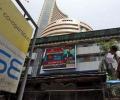
Among the Sensex constituents, as many as 16 stocks closed with losses with Nestle India, Kotak Mahindra Bank, IndusInd Bank, Bajaj Finserve, Titan and JSW Steel being the major laggards. Index major Reliance, Hindustan Unilever, Maruti and Tata Steel also declined due to selling pressure. In contrast, NTPC, TCS, Tech Mahindra, Bajaj Finance bucked the trend and ended the day in green. Axis Bank, Bharti Airtel, Mahindra & Mahindra and Tata Motors also defied the trend.

In January, SIP account closures surpassed new registrations for the first time.
